
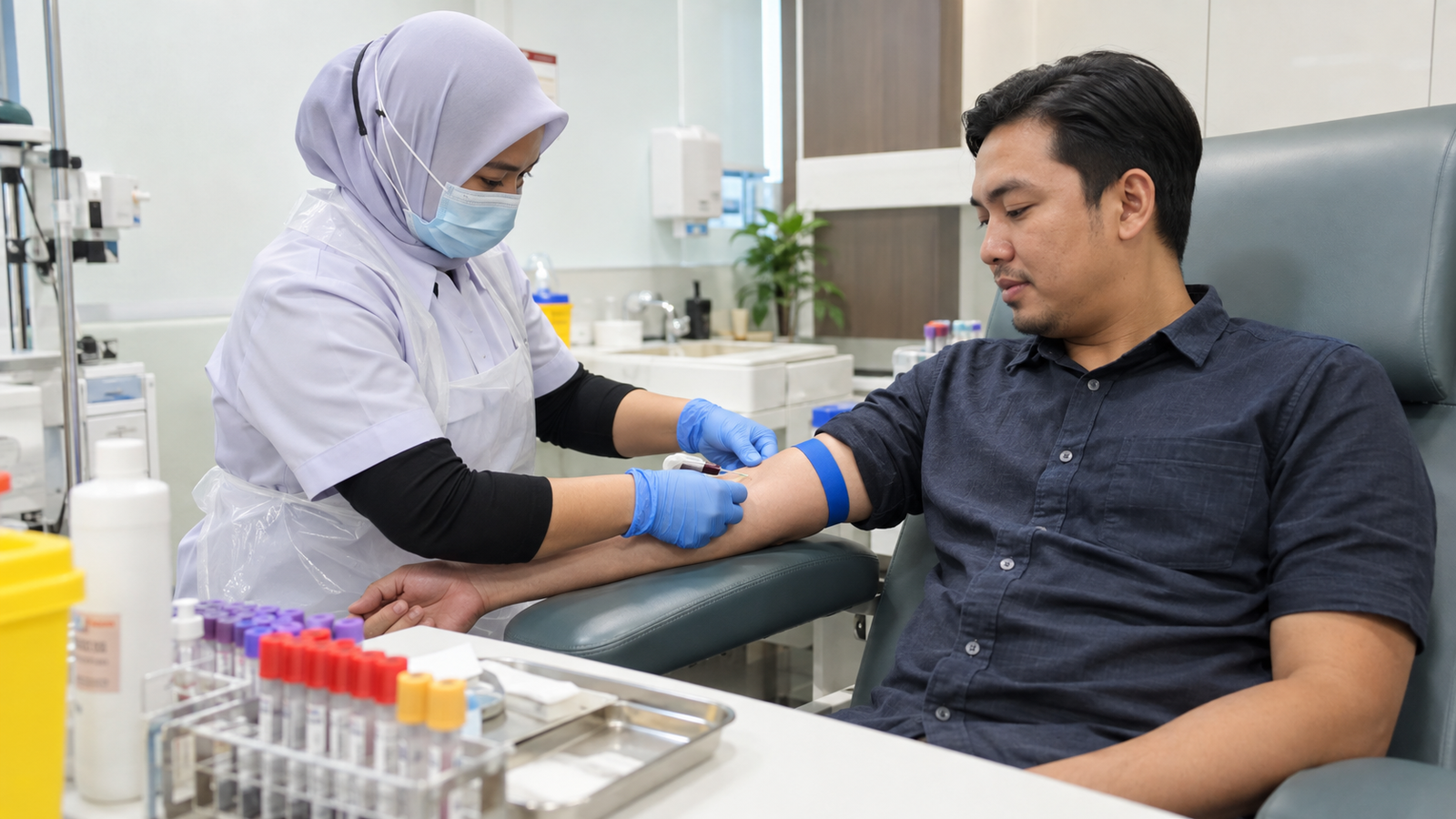
An allergy test identifies the specific substances (allergens) that trigger your body’s immune response. Allergies can cause a wide range of symptoms — from sneezing, nasal congestion, and itchy eyes (allergic rhinitis) to skin rashes, hives (alahan kulit), digestive problems, and in severe cases, life-threatening anaphylaxis. Knowing exactly what you are allergic to is the first step toward effective treatment and prevention.
At U.n.i Klinik Sandakan, we offer comprehensive allergy testing and treatment to help you identify your triggers and manage your symptoms. Our doctor will assess your history, recommend the most appropriate test whether a blood-based IgE blood test, skin scraping, or skin biopsy and work with you on a personalised treatment plan.
An allergy test is recommended if you experience recurring or unexplained symptoms that may be allergy-related. Consider getting tested if:
*Many people live with allergy symptoms for years without knowing their specific triggers. An allergy test takes the guesswork out and allows you and your doctor to target the root cause rather than just managing symptoms.
Our clinic offers the following allergy testing methods. Our doctor will recommend the most appropriate test based on your symptoms, medical history, and suspected allergens:
Test Type | How It Works | Best For |
IgE Blood Test | A blood sample is drawn and sent to the laboratory to measure the level of Immunoglobulin E (IgE) antibodies in your blood. IgE is the antibody your immune system produces in response to allergens. Results typically take 3 to 5 working days. | A first-line screening test to determine whether an allergic process is likely. Useful for patients who cannot undergo skin testing, including those on antihistamines or with widespread skin conditions. Often used as a starting point before more specific testing. |
Specific IgE Blood Test | A blood sample is drawn and sent to the laboratory to measure IgE antibody levels against specific allergens. Results typically take 3 to 7 working days. | Useful when skin prick testing is not suitable for example, patients on antihistamines, those with severe eczema, or when testing for a wider panel of food allergens. Also used for drug allergy investigation. |
Total IgE Test | A blood test measuring the overall level of IgE antibodies in your blood. Elevated total IgE may suggest an allergic condition but does not identify the specific allergen. | Used as a screening tool to determine whether an allergic process is likely. Often combined with specific IgE testing for a complete picture. |
Skin Scraping | A small sample of skin cells is gently scraped from the surface of an affected area using a blunt blade or curette. The sample is collected onto a glass slide and examined under a microscope. The procedure is quick and causes minimal discomfort. | Used to investigate skin rashes, scaly patches, or persistent itching that may be caused by fungal infections (e.g. ringworm, tinea), scabies, or other skin conditions that mimic allergic dermatitis. Helps our doctor distinguish between an allergic skin reaction and an infection requiring different treatment. |
Skin Biopsy | A small sample of skin tissue is removed under local anaesthesia using a punch biopsy tool or scalpel. The sample is sent to a laboratory for histopathological examination (analysis under a microscope by a pathologist). Results typically take 1 to 2 weeks. | Recommended when a skin rash, lesion, or allergic reaction does not respond to standard treatment and a definitive diagnosis is needed. Helps identify conditions such as chronic urticaria, dermatitis, eczema subtypes, drug eruptions, vasculitis, or other inflammatory or autoimmune skin conditions that overlap with allergy symptoms. |
Not sure which test you need? Our doctor will assess your symptoms and history during the consultation and recommend the best approach. In some cases, a combination of skin testing and blood testing may provide the most comprehensive result.

Depending on the test method and your symptoms, we can screen for a range of common allergens including:
Identifying your allergens is only the first step. Our doctor will work with you on a practical allergy treatment plan tailored to your specific triggers and lifestyle:
Once your triggers are confirmed, our doctor will provide specific advice on how to reduce or eliminate exposure. For dust mite allergies, this may include mattress encasings, regular washing of bedding at high temperatures, and reducing soft furnishings. For food allergies, clear guidance on which foods to avoid and how to read ingredient labels.
Depending on the type and severity of your allergy, our doctor may prescribe medications to control symptoms. These may include antihistamines (oral or nasal), nasal corticosteroid sprays, eye drops, topical creams for skin allergies, or bronchodilators for allergy-related asthma. Our doctor will explain how each medication works and when to use it.
If you are at risk of a severe allergic reaction (anaphylaxis), our doctor will advise on how to recognise early warning signs, when to seek emergency help, and whether you should carry an emergency adrenaline auto-injector. This is especially important for patients with confirmed food or insect venom allergies.
For complex cases such as severe or multiple allergies, suspected drug allergy, or cases requiring allergen immunotherapy (desensitisation), our doctor will refer you to an allergist or immunologist for further evaluation and specialised treatment.
Your visit begins with a detailed consultation. Our doctor will ask about your symptoms, when they occur, possible triggers, family history of allergies, and any previous allergy testing or treatment. This helps determine which allergens to test for and which test method is most appropriate.
Depending on your symptoms and the doctor's assessment, one or more tests may be performed during your visit: • IgE blood test — blood sample drawn and sent to the laboratory, results in 3 to 7 working days • Skin scraping — gentle scraping of the affected skin area, sample examined under a microscope • Skin biopsy — small tissue sample taken under local anaesthesia, sent for laboratory analysis, results in 1 to 2 weeks Our doctor will explain why a particular method is chosen for your case and what to expect from each test.
Skin scraping results may also be available the same day if examined in-clinic. Blood test and skin biopsy results typically take several working days. Once all results are in, our doctor will review them with you, explain which allergens you reacted to or what the biopsy findings show, discuss the severity, and outline a personalised treatment plan including avoidance strategies, medication, and follow-up.
Yes. All allergy testing methods offered at our clinic are safe and widely performed worldwide.
Our doctor is trained to manage allergic reactions and has emergency equipment available in the clinic as a precaution. Allergy testing is safe for both adults and children.
Every allergy test result is interpreted by our qualified doctor, not a technician or automated report. You receive a clear explanation of your triggers and a practical treatment plan.
We offer multiple testing approaches: IgE blood test, skin scraping, and skin biopsy so our doctor can choose the most appropriate method for your specific condition.
For skin scraping, results are often available during the same visit. Our doctor can start your treatment plan immediately so you leave with answers and a clear next step.
Open Monday to Sunday, 9:00 AM to 10:00 PM. No referral needed. Walk in or book ahead via WhatsApp.
For skin prick testing, yes. Antihistamines should be stopped 3 to 7 days before the test (depending on the type) as they can suppress the skin reaction and give false-negative results. Blood-based IgE tests are not affected by antihistamines, which is one reason they may be preferred for patients who cannot stop their medication. Our doctor will advise you on preparation when you book.
A skin prick test takes about 30 to 40 minutes in total — 10 minutes for setup and 15 to 20 minutes to read the results. A blood test takes only a few minutes for the blood draw, with laboratory results returning within 3 to 7 working days.
The skin prick test involves a very light prick on the surface of the skin — most patients describe it as a mild scratch, not a needle prick. It may cause slight itching at the test sites for positive reactions, which resolves within an hour. The blood test involves a standard blood draw.
Yes. Allergy testing is safe for children and is commonly performed from as young as 6 months of age for blood tests, and from around 2 to 3 years for skin prick tests. Our doctor will recommend the most suitable method based on the child's age and symptoms.
A food allergy involves the immune system (IgE-mediated) and can cause rapid symptoms such as hives, swelling, vomiting, or anaphylaxis within minutes to hours of eating the trigger food. Food intolerance (e.g. lactose intolerance) does not involve the immune system and typically causes digestive symptoms like bloating and diarrhoea. Allergy tests detect IgE-mediated food allergies. Food intolerance is diagnosed through a different process, often involving elimination diets.
Most allergies cannot be cured permanently, but they can be effectively managed through a combination of allergen avoidance, medication, and in some cases, allergen immunotherapy (desensitisation). Our doctor will discuss the most effective management approach for your specific allergens.
Stop guessing what is causing your symptoms. Book an allergy test at U.n.i Klinik Sandakan and find out exactly what you are allergic to so you can take control of your health and start feeling better.